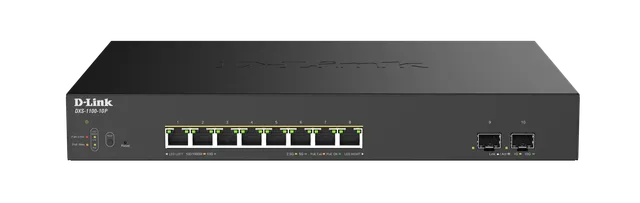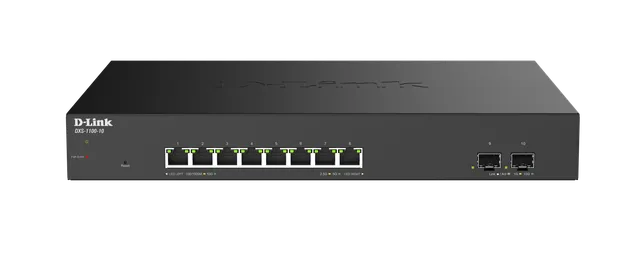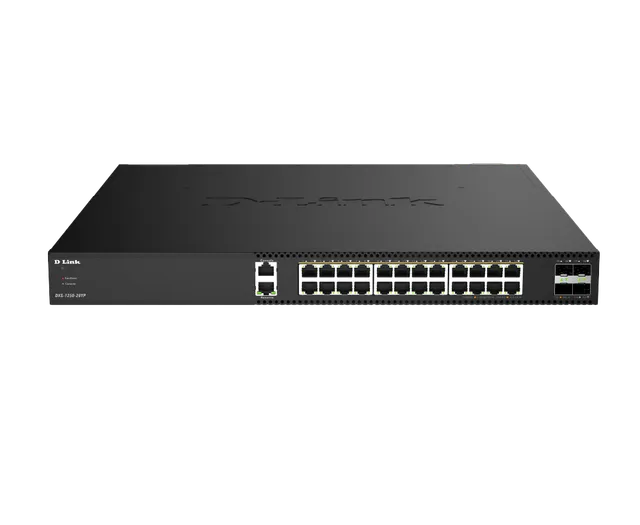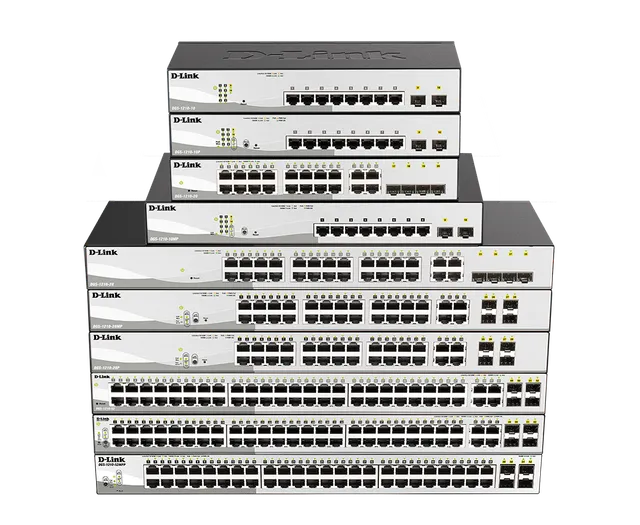
The D-Link DGS-F1210-26PS-E is a 26 port Managed Gigabit Switch with 24 10/100/1000 Mbps PoE ports, 2 Gigabit SFP uplink ports. This Switch enables users to easily connect and supply power to PoE-capable devices such as wireless Access Points (APs), IP cameras.
DGS-F1210-26PS-E
Layer 2 Gigabit Managed Long Range PoE+ Switch
- 24 10/100/1000 Mbps PoE ports
- 2 Gigabit SFP Ports
- 400 watts available for PoE
- Flow control for protection against data loss
- Maximum distance of 250m
- IEEE 802.3 10BASE-T Ethernet (twisted-pair copper)
- IEEE 802.3u 100BASE-TX Fast Ethernet (twisted pair copper)
- IEEE 802.3ab 1000BASE-T Gigabit Ethernet (twisted pair copper)
- IEEE 802.3z 1000 BASE-X (fiber-optic)
- IEEE 802.3af Power over Ethernet
Overview
Power Over Ethernet
The DGS-F1210-26PS-E supports both IEEE 802.3at and IEEE 802.3af PoE protocol. A total PoE budget of 400 watts allows users to attach an IEEE 802.3af-compliant device to the DGS-F1210-26PS-E without requiring additional power. PoE is especially suitable for devices that are far from power outlets or when users want to minimize the clutter of extra cables as power is supplied via the Ethernet cables themselves.
Switch Working Mode
Using a DIP switch, the working mode of DGS-F1210-26PS-E can be changed.
- Extend Mode: 1-8 ports support 250 meters long distance power supply (should use Cat5e or Cat6 cable)
- Port Isolation Mode: Isolating ports 1-24 to each other can effectively suppress network storms and improve network performance.
- QoS Mode: Customize application priority to improve network sensitivity. For example, with video priority, monitoring transmission is more smooth.
- PD Alive Mode: Automatically detect the power receiving port, find the dead device, power off and restart the devices.
DGS-F1210-26PS-E
Specifications
| Network Interface | 24 x 10/100/1000 Mbps PoE RJ45 ports (port1~port24) 2 Gigabit SFP Ports |
|---|---|
| Console Port | RJ45 |
| DIP Switches | VLAN, Extend, PoE, QoS |
| Transmission Rate | 10/100/1000Mbps Each port supports MDI/MDIX auto-flip and auto-negotiation Network interface: 10BASE-T or 100BASE-TX, 1000BASE-T Ethernet RJ-45 port |
| Protocols and Standards | IEEE802.3 10BASE-T IEEE 802.3u 100BASE-TX ANSI/IEEE 802.3 NWay auto-negotiation IEEE802.3ab 1000BASE-T IEEE802.3z 1000 BASE-X IEEE802.3x Flow Control IEEE 802.3af/at standard |
| Switching Capacity | 52 Gbps |
| Packet Forwarding | 38.688 Mpps |
| Packet Buffer Memory | 4.1 Mbits |
| DRAM | 128 MB |
| Flash Memory | 16 MB |
| LED's Indicator PoE | Power, SYS, LINK/ACT, PoE |
| Budget | 400 W |
| MAC Address Table | 8K Entries |
| Power | 100-240 VAC, 50-60 Hz |
| Lightning protection | 6 KV |
| Max Power Consumption | 410W |
| Physical Characteristics | Dimensions (LxWxH): 440 x 293 x 44 mm Weight: 3.2 kg |
| Environmental Parameter | Operating Temperature: 0 to 40 °C (32 to 104 °F) Operating Humidity: 10% to 90% non-condensing |
| Protocol Standard | IEEE 802.3: Ethernet Media Access Control (MAC) Protocol IEEE 802.3i: 10BASE-T Ethernet IEEE 802.3u: 100BASE-TX Fast Ethernet IEEE 802.3ab: 1000BASE-T Gigabit Ethernet IEEE 802.3z: 1000BASE-X Gigabit Ethernet (fiber) IEEE 802.3ad: Standard method for performing link aggregation IEEE 802.3x: flow control IEEE 802.1p: LAN Layer 2 QoS/CoS protocol for traffic priority (multicast filtering) IEEE 802.1q: VLAN IEEE 802.1d: STP Spanning tree IEEE 802.1s: MSTP Spanning tree IEEE 802.1w: RSTP Spanning tree IEEE 802.3af IEEE 802.3at |
| DHCP | DHCP Snooping |
| VLAN | 4K VLAN 802.1Q VLAN, MAC VLAN, IP VLAN Voice VLAN |
| MAC Address Table (Software Specification) | Comply with the IEEE 802.1d standard MAC address learning and aging automatically Static, dynamic, filter address table |
| Security | Password protection Based on the port number, IP address, MAC address restrictions on user access HTTPS, SSL V3, TLS V1, SSH V1/V2 IP-MAC-PORT ternary binding ARP protection, IP source protection, DoS protection DHCP Snooping, DHCP attack protection 802.1X, AAA Port security, port isolation CPU protection |
| POE management | POE power limit POE chip status view PoE port priority PoE power supply time period |
| Access control (ACL) | L2 (Layer 2) ~ L4 (Layer 4) packet filtering Port mirroring, port redirection, flow rate limiting, QoS re-marking |
| Quality of Service (QoS) | 8 port queue Port priority, 802.1p priority, DSCP priority SP, RR, WRR, WFQ Priority scheduling algorithm |
| Spanning Tree | STP (IEEE 802.1d), RSTP (IEEE 802.1w) and MSTP (IEEE 802.1s) protocol Loop protection, root bridge protection, TC protection, BPDU protection, BPDU filtering |
| Multicast | IGMP v1/v2 Snooping, IGMP v3 awareness Fast leave mechanism Multicast VLAN Multicast filtering, packet statistics, and unknown multicast discards. |
| Storm suppression | Multicast suppression Broadcast suppression Unknown unicast suppression |
| Link aggregation | Static aggregation Dynamic aggregation IP, MAC, and hybrid load balancing modes Up to 32 aggregation groups |
| IPv6 | IPv6 Ping, IPv6 Tracert, IPv6 Telnet IPv6 SSH, IPv6 SSL |
| Management and maintenance | WEB network management (HTTP, HTTPS, SSL V3) CLI (Telnet, SSH V1/V2, local serial port) SNMP V1/V2/V3 LLDP, RMON ARP protection, IP source protection, DoS protection CPU monitoring, memory monitoring System log, grading warning Ping, Tracert detection, cable detection |
Actual performances may vary due to settings, cabling, temperature, network configuration, interface, device compatibility, environmental and on-site conditions, and other similar factors. References to power capability, signal or processing speed, signal range or distance, data encryption, storage capacity, display properties, or other performance metrics are based on optimal conditions derived from industry standards and provided for informational purposes only. Specifications may be subject to change without prior notice.