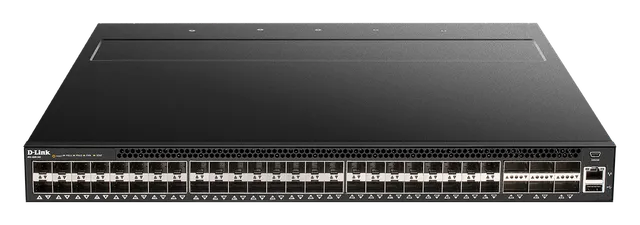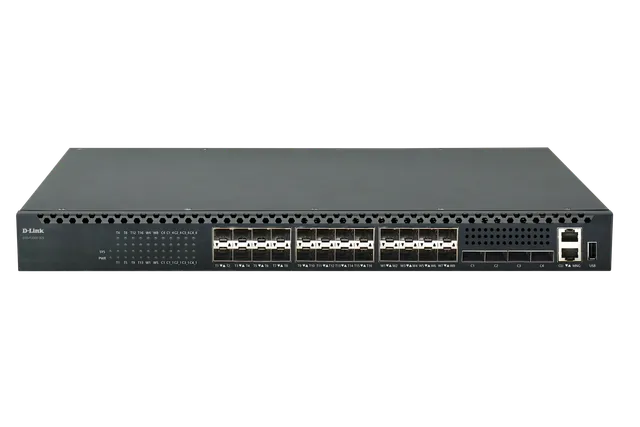
D-Link's new generation DXS-F3500-64S switch delivers a versatile feature set and a high density port count in a 1U rack mount size, suitable for Data Center TOR or Enterprise & campus environments' CORE/Aggregation requirements. The DXS-F3500-64S high-performance switches feature wire-speed 10/40/100 Gigabit Ethernet switching, routing at ultra-low latency. DXS-F3500-64S provides 48x10-Gig, 2x40-Gig ports & 4x100G/40G ports in compact 1U size.
DXS-F3500-64S
High Port Density Data Center TOR Switch
- 10 Gigabit Connectivity: High bandwidth uplinks eliminate network bottlenecks and provide low-latency connections for network servers and storage
- High Performance: Get the speeds your network needs with up to 1.92Tbps switching capacity and 1440 Mpps forwarding
- Reliability: The DXS-F3500-64S supports dual load sharing for AC/DC power, as well as Data Center Bridging to provide "lossless Ethernet" transmission quality
- Two AC/DC hot-swappable power modules for 1+1 redundancy and load sharing.
- Four hot-swappable fan trays provide N+1 cooling redundancy.
- Supports Virtual Switching Unit (VSU) by leveraging Multi Chassis Trunking (MCT) to avoid single point of failure.
- Ethernet Ring Protection Switching (ERPS) / Ethernet Automatic Protection Switching (EAPS)
- Port mirroring/Bandwidth Control
- Broadcast/Multicast/Unicast storm control
- Single Rate Three Color Marker (srTCM)
Overview
High Availability and Flexibility
The DXS-F3500-64S switch features a modular power supply design for a high availability architecture. The hot-swappable design means that power supplies can be replaced without affecting switch operation. The Multi Chassis Trunking enables multiple DXS-F3500-64S switches to be configured in a Virtual chassis and can provide non-stop layer-3 routing forwarding even in case of failure of any switch in the virtual chassis.
Features
High Availability and Flexibility
- Two AC/DC hot-swappable power modules for 1+1 redundancy and load sharing.
- Four hot-swappable fan trays provide N+1 cooling redundancy.
- Supports Virtual Switching Unit (VSU) by leveraging Multi Chassis Trunking (MCT) to avoid single point of failure.
- Ethernet Ring Protection Switching (ERPS) / Ethernet Automatic Protection Switching (EAPS)
Traffic Monitoring and Bandwidth Control
- Port mirroring/Bandwidth Control
- Broadcast/Multicast/Unicast storm control
- Single Rate Three Color Marker (srTCM)
- Two Rate Three Color Marker (trTCM)
DXS-F3500-64S
Specifications
| Interfaces | 48 10-Gig SFP+, 2 40-Gig QSFP+ & 4 100G/40G QSFP28 Ports |
|---|---|
| Hardware Version | B2 |
| Console Port | RJ-45 and Mini USB console ports for out-of-band CLI management |
| Management Port | 10/100/1000BASE-T RJ-45 Ethernet for out-of-band IP management |
| USB Port | A-Type Port |
| Switching Capacity | 1.92 Tbps |
| Max. Forwarding Rate | 1440 Mpps |
| Packet Buffer Memory | 9 MB |
| MAC Address Table | 64K |
| Power Input | Dual Redundant AC Power supplies (100 to 230 V AC) Dual Redundant DC Power supply 36V ~ 72V (Available on request) |
| Dimensions | 442.5 x 404 x 44 mm (W x D x H) 1U |
| Operating Temperature | 0° to 50° C |
| Storage Temperature | -20° to 70° C |
| Operating Humidity | 10%-90% non-condensing |
| Storage Humidity | 5%-95% non-condensing |
| Safety | RoHS |
| Virtual Switching Unit (VSU) | Multi Chassis Trunking |
| VSU Devices | Up to 4 Devices via 10G and 40G |
| Layer 2 Features | MAC Address Table: up to 64K entries Flow Control: 802.3x Flow Control when using full-duplex, Back Pressure when using half-duplex, HOL Blocking Prevention Spanning Tree Protocol: 802.1D STP, 802.1w RSTP, 802.1s MSTP, Root Guard, Loop Guard Jumbo Frame: up to 16K 802.1AX Link Aggregation: max. 8 groups per device ERPS (Ethernet Ring Protection Switching) Port mirroring: supports one-to-one, many-to-one; supports mirroring for Tx/Rx/both; supports 4 mirroring groups Flow mirroring: supports mirroring for Rx VLAN mirroring L2 protocol tunneling Loopback Detection (LBD) |
| L2 Multicast Features | MLD Snooping: MLD v1/v2 Snooping, supports 256 groups, host-based MLD Snooping Fast Leave, supports 64 static MLD groups, MLD Snooping Querier, per-VLAN MLD Snooping, MLD Proxy Reporting IGMP Snooping: IGMP v1/v2/v3 Snooping, supports 8K IGMP groups, supports 64 static IGMP groups, per VLAN IGMP Snooping, IGMP Snooping Querier, host-based IGMP Snooping Fast Leave PIM Snooping |
| Layer 3 Multicast | IGMP v1/v2/v3 MLD v1/v2 IGMP/MLD Proxy PIM-SM |
| L3 Features | ARP: 512 static ARP, supports Gratuitous ARP, ARP Proxy Loopback interface UDP helper IPv6 Neighbor Discovery (ND) IGMP Proxy Reporting VRRP v2/v3 IP Interface: supports 256 interfaces |
| L3 Routing | Static routing: max. 8K IPv4 entries, max. 4K IPv6 entries, supports Route Redistribution, supports secondary route Supports hardware routing entries shared by IPv4/IPv6: max. 8K IPv4 entries, max. 4K IPv6 entries Supports hardware L3 forwarding entries shared by IPv4/IPv6: max. 8K IPv4 entries, max. 4K IPv6 entries Default routing Policy-based Route (PBR) Null route Bidirectional Forwarding Detection (BFD): IPv4/IPv6 static route, RIP, VRRP RIP: RIP v1/v2, RIPng Graceful Restart (GR) Helper for RIP Route Redistribution: default route, static route, RIP, RIPng, null route OSPF: OSPF v2/v3, OSPF Passive Interface, Stub/NSSA Area Graceful Restart (GR) Helper for OSPF Route Preference: OSPF v2/v3 Route Redistribution: OSPF v2/v3 Bidirectional Forwarding Detection (BFD): OSPF BGP4+ |
| VLAN | 802.1Q 802.1v Double VLAN (Q-in-Q): port-based Q-in-Q Selective Q-in-Q Port-based VLAN MAC-based VLAN Subnet-based VLAN Private VLAN VLAN group: max. 4K static VLAN groups, max. 4094 VIDs ISM VLAN (multicast VLAN) Voice VLAN Auto Surveillance VLAN VLAN trunking GVRP: up to 227 dynamic VLANs |
| AAA | 802.1X authentication: supports port-based access control, supports host-based access control, identity-driven policy assignment (Dynamic VLAN assignment, QoS assignment, ACL assignment) MAC-based Access Control (MAC): identity-driven policy assignment (QoS assignment, ACL assignment), supports port-based access control, supports host-based access control Compound Authentication RADIUS and TACACS+ authentication Authentication Database Failover Guest VLAN |
| Quality of Service (QoS) | 802.1p Quality of Service: 8 queues per port QoS based on: 802.1p Priority Queues, DSCP, IP address, MAC address, VLAN, IPv6 traffic class, IPv6 Flow Label, TCP/UDP port, switch port, EtherType, ToS/IP Preference, protocol type Congestion Control: WRED Queue handling: Strict, Weighted Round Robin (WRR), Strict + WRR, Deficit Round Robin (DRR), Weighted Deficit Round Robin (WDRR) Bandwidth control: port-based (ingress/egress, min. granularity 64 Kb/s), flow-based (ingress/egress, min. granularity 64 Kb/s), per queue bandwidth control (min. granularity 64 Kb/s) Support for following actions: remark 802.1p priority tag, remark ToS/DSCP tag, Committed Information Rate (CIR) Three Color Marker: trTCM, srTCM |
| Access Control List (ACL) | ACL based on: 802.1p priority, VLAN, MAC address, Ether Type, IP address, DSCP, protocol type, TCP/UDP port number, IPv6 traffic class, IPv6 Flow Label Max. ACL entries: Ingress (IPv4: 2K, IPv6: 2K), Egress (IPv4: 2K, IPv6: 2K), 3K VLAN access map Time-based ACL |
| Security | Port Security: supports up to 12K MAC addresses per port/system Broadcast/multicast/unicast storm control DHCP server screening IP-MAC-Port Binding Dynamic ARP Inspection IP Source Guard DHCP Snooping IPv6 Snooping DHCPv6 Guard IPv6 Route Advertisement (RA) Guard IPv6 ND Inspection ARP Spoofing Prevention: max. 64 entries L3 Control Packet Filtering Traffic Segmentation SSH: supports SSH v2, supports IPv4/IPv6 access BPDU attack protection |
| Management | Web-based GUI CLI Telnet server Telnet client TFTP client FTP client Secure FTP (SFTP) server Traffic monitoring SNMP: supports v1/v2c/v3 SNMP Trap System log DHCP client DHCP server DHCP Relay options 60, 61, 82 Multiple images Multiple configurations Flash file system DNS client CPU monitoring MTU setting ICMP tools: Ping, Traceroute LLDP & LLDP-MED DNS Relay SMTP DHCP Auto Configuration NTP RCP (Remote Copy Protocol) RMON v1/v2 Trusted host Password encryption Debug command |
Actual performances may vary due to settings, cabling, temperature, network configuration, interface, device compatibility, environmental and on-site conditions, and other similar factors. References to power capability, signal or processing speed, signal range or distance, data encryption, storage capacity, display properties, or other performance metrics are based on optimal conditions derived from industry standards and provided for informational purposes only. Specifications may be subject to change without prior notice.